

The Story of Botanical Ingredients: Tradition, Culture and Modern Uses

The Story of Botanical Ingredients: Tradition, Culture and Modern Uses
Throughout human history, plants have meant far more than simple nourishment. Across cultures, botanical ingredients played a role in everyday food, rituals, traditional knowledge systems, and observation-based ways of using nature.
Archaeological, historical and ethnobotanical research suggests that people observed plants for thousands of years — their colour, taste, behaviour, how they could be prepared, and how they responded in different environments and uses. This knowledge did not emerge overnight. It developed gradually, through long-term observation and shared experience, then passed from one generation to the next.
Many ingredients we now associate with drinks, desserts, modern culinary applications or naturally expressive colour once belonged to very different cultural settings. Some were part of traditional diets, some appeared in ritual contexts, and others were valued for their striking pigments or distinctive properties.
The story of botanical ingredients is therefore not only about the past. It also shows how old knowledge continues to live on in today’s kitchens, drinks, desserts and increasingly visual forms of gastronomy.
Spirulina – a microalgae rooted in ancient food cultures
Spirulina is a microscopic cyanobacterium that naturally forms large colonies in alkaline lakes. Today it is often seen as a modern superfood, yet its relationship with human food culture goes back much further.
Historical accounts suggest that the Aztec civilisation collected spirulina from Lake Texcoco and consumed it in dried form before the 16th century. Another long-standing example comes from Africa, where communities around Lake Chad prepared spirulina-based food over extended periods of time.
Spirulina is especially interesting because it contains naturally occurring pigments, including phycocyanin, which gives its extract an intense blue colour. That visual quality is one of the reasons why it now plays such a striking role in modern drinks, smoothies, desserts and creative presentation.
Related internal links:
Blue Spirulina: An Ancient Story of Lakes, Warriors and Tradition
Green Spirulina vs. Blue Spirulina
Butterfly Pea – a traditional flower in Southeast Asian culture
Clitoria ternatea, commonly known as butterfly pea, is native to Southeast Asia. Its distinctive deep blue petals have been recognised and valued in the region for centuries.
Historical and botanical records show that butterfly pea flowers were traditionally used in drinks, infusions and various local preparations. What makes the flower remarkable is not only its origin, but also the vivid natural pigments found in its petals.
One of butterfly pea’s most recognisable characteristics is its colour shift in acidic environments. Its blue tone can move into purple or pink shades when combined with ingredients such as lemon. What is now widely appreciated as a visually dramatic drink or dessert element is, in fact, rooted in a naturally occurring plant property that has been known for a long time.
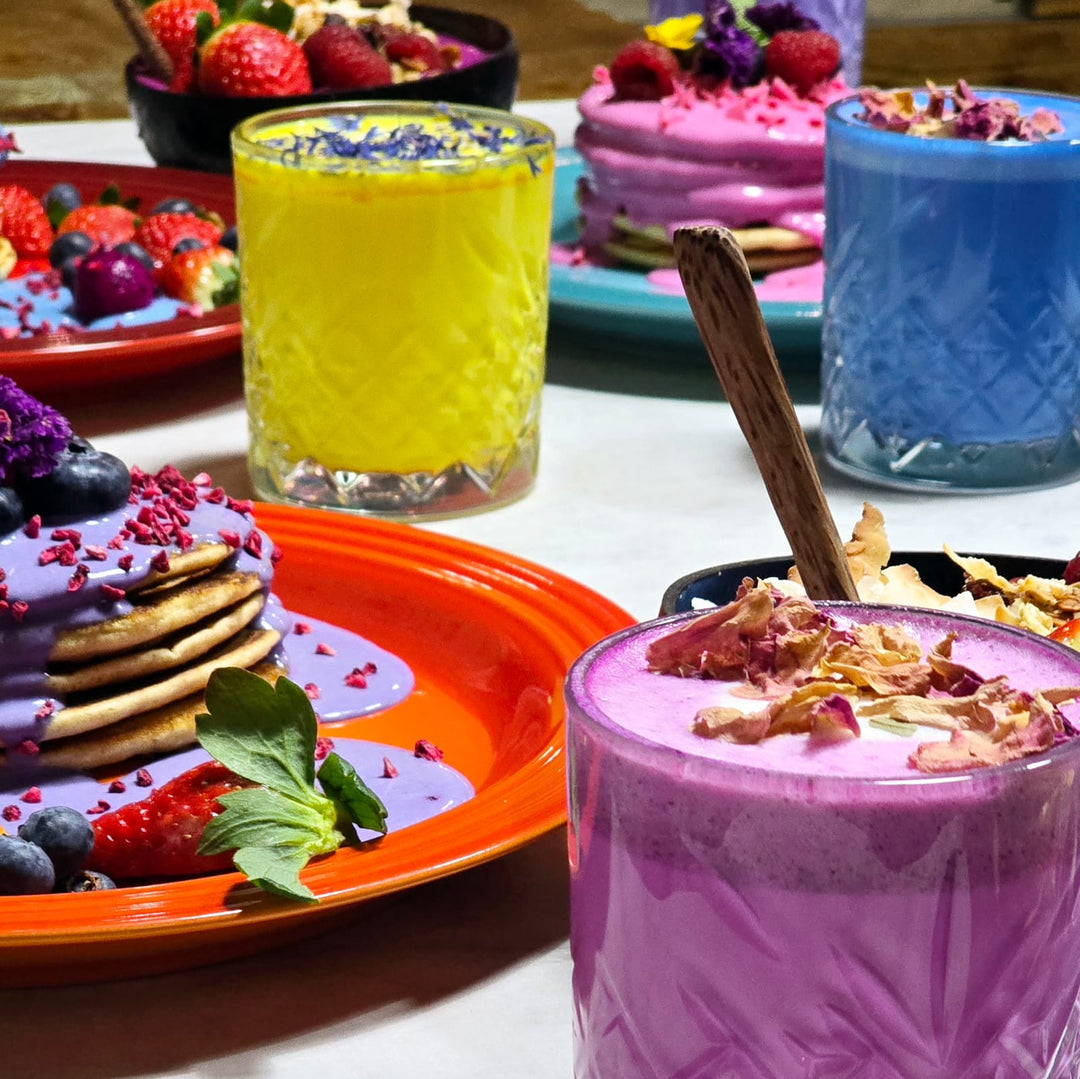
Butterfly pea is therefore a strong example of how traditional botanical knowledge can meet contemporary gastronomy. What once existed in regional cultural practice is now reinterpreted in lattes, lemonades, cocktails, desserts and visually expressive food styling.
Related internal links:
Butterfly Pea: A Blue Flower With a Centuries-Old Cultural Story
Turmeric – one of the best-known botanical ingredients in traditional cultures
Curcuma longa, or turmeric, is one of the most recognisable botanical ingredients in Indian tradition. Its use dates back thousands of years, and it has held a visible place in culinary, cultural and ceremonial contexts.
Historically, turmeric was not only used in cooking. Its bright yellow colour also gave it significance as a dye and as part of traditional cultural practices. In India, turmeric became closely associated with both daily use and ceremonial life, where colour itself often carried symbolic meaning.
Today, curcumin is one of the best-known compounds associated with turmeric, but the ingredient continues to be appreciated not only for its composition, but for its strong visual identity and culinary versatility. In modern kitchens, turmeric appears in drinks, desserts and ingredient-led creations that still carry traces of its long cultural background.
Related internal links:
Golden Turmeric Latte with Curcumin
Matcha – tea culture and the tradition of powdered leaves
The story of matcha belongs to the wider history of tea culture. Early forms of powdered tea emerged in China, before later becoming deeply significant in Japan, where this style of preparation developed into one of the best-known expressions of tea tradition.
Matcha’s distinctive character comes from the way shaded tea leaves are processed and finely ground into powder. This method shapes the drink’s colour, texture and overall sensory profile. Matcha therefore matters not only as a beverage, but also as a visual and textural ingredient.
What began in traditional tea culture has since moved well beyond ceremonial preparation. Today, matcha appears in specialty drinks, desserts, pastries and modern ingredient-focused kitchens, while still retaining its cultural associations.
Related internal links:
The Story of Matcha – A Tradition Rooted in Nature
Black carrot – a historical source of natural colour
Black carrot is especially rich in anthocyanin pigments, which makes it an interesting botanical ingredient from the perspective of naturally intense colour. Dark carrot varieties have long been associated with regions of the Middle East and parts of Asia, where they developed culinary significance in different forms.
What makes black carrot remarkable is not only its colour, but the way deeply pigmented botanical ingredients have historically attracted attention in food cultures where appearance and natural origin both mattered. Its rich burgundy-purple shade continues to make it relevant in contemporary gastronomy.
Today, black carrot works especially well in drinks, baking, desserts and visually expressive recipes where natural colour is part of the experience.
Related internal links:
Black Carrot – The Deep Purple Root Rich in Natural Goodness
Dragon fruit – a tropical fruit with vivid colour traditions
Dragon fruit, also known as pitaya, originally comes from Central America, where it was already known in pre-Columbian cultures. Over time it spread to other regions, especially across Asia, and is now one of the most recognisable tropical fruits worldwide.
One of dragon fruit’s most striking features is its vivid colour, which is connected to betalain pigments. That visual intensity is part of what makes it so appealing in modern culinary uses where naturally expressive colour matters.
Today, dragon fruit is not only known as a fresh fruit, but also as a powder used in smoothies, yoghurt, desserts and visually focused recipes. Its story shows how a plant with a regional cultural background can become a globally used contemporary ingredient.
Related internal links:
The Story of Dragon Fruit Powder: Origins, Culture & Craft
Activated charcoal – a material with ancient historical references
The use of charcoal dates back thousands of years. Historical records suggest that forms of charcoal were already known in ancient Egypt around 1500 BCE, and later appeared in the writings of Greek and Roman authors as well.
Today, activated charcoal has become especially interesting in modern visual gastronomy because of its intense black colour. It is used in striking drinks, baked goods, desserts and decorative culinary applications where contrast and presentation matter.
The historical references and the modern culinary form do not belong to the same context, but they do show how strongly characterful natural materials have long attracted human attention.
Related internal links:
What can we learn from the history of botanical ingredients?
The history of traditional plant use shows that human communities observed nature over long periods of time and gradually built knowledge that later became part of cultural tradition. Botanical understanding did not develop in isolation. It was shaped through food, local customs, rituals and everyday practice.
Today, these ingredients are often seen through a different lens. Yet there is a clear connection between past and present: what was once valued for its colour, processing behaviour or cultural significance is now being rediscovered in contemporary gastronomy, drinks, desserts and creative kitchen use.
Modern research continues to study plant-derived materials, while modern food culture continues to reinterpret them. In that sense, the value of botanical ingredients lies not only in where they come from, but in how many ways they can still be used today.
Further internal links:
HOW TO USE THE YES SUPERFOOD POWDERS
8 Tips for Making the Perfect Superfood Latte
Natural Colouring for Kids’ Meals
Scientific references
• Ethnobotany and the Search for New Drugs
• Spirulina in Human Nutrition and Health